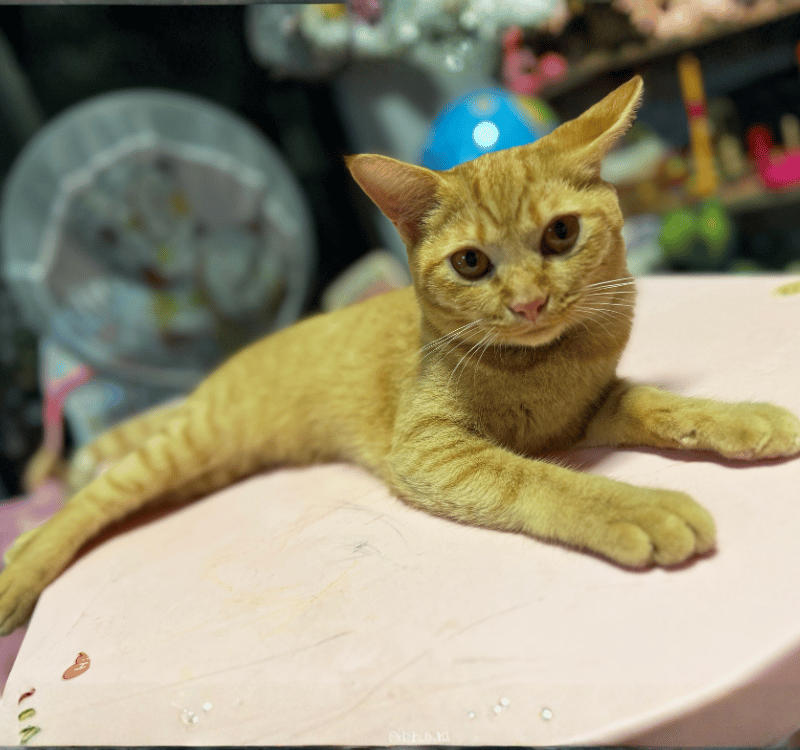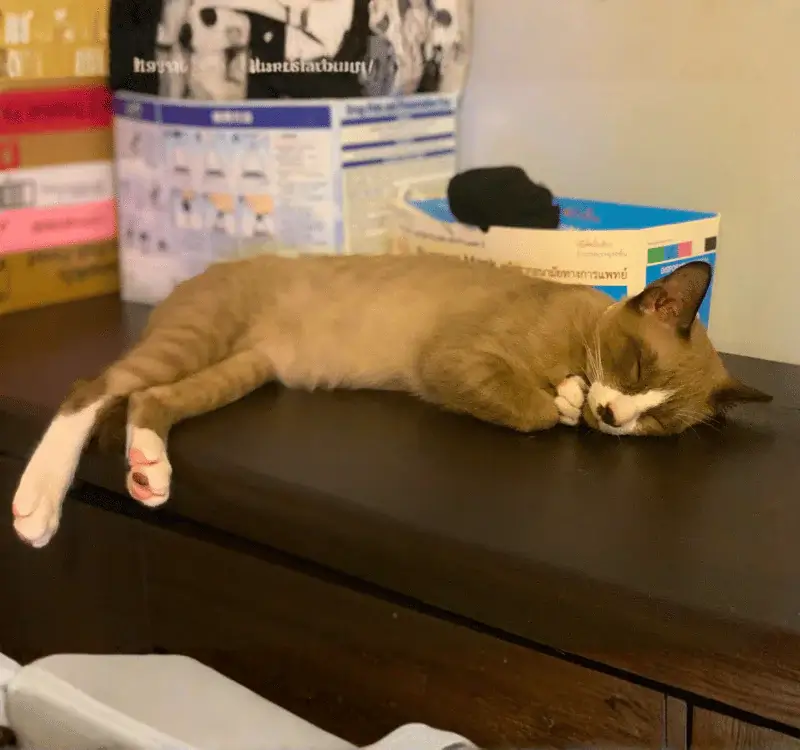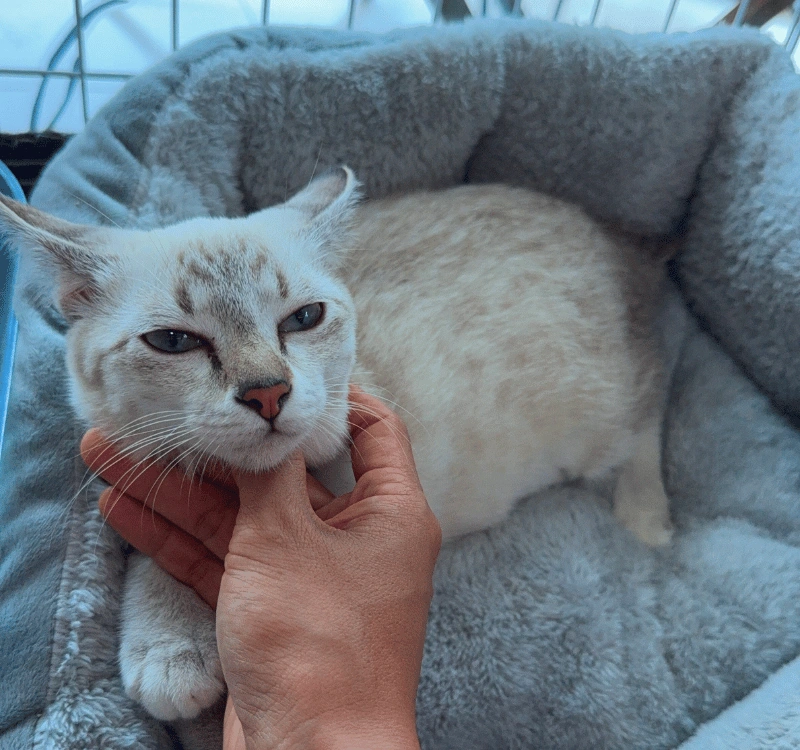
Named after: Sir Charlie Chaplin, the silent‑film legend who made the world smile without saying a word.
Personality: Charlie is playful, curious, and full of mischief — the gentleman clown of our café.
Rescue Story: Rescued from Rayong with a past of uncertainty but a heart full of joy. Now his happy energy fills every corner like vintage laughter on film.
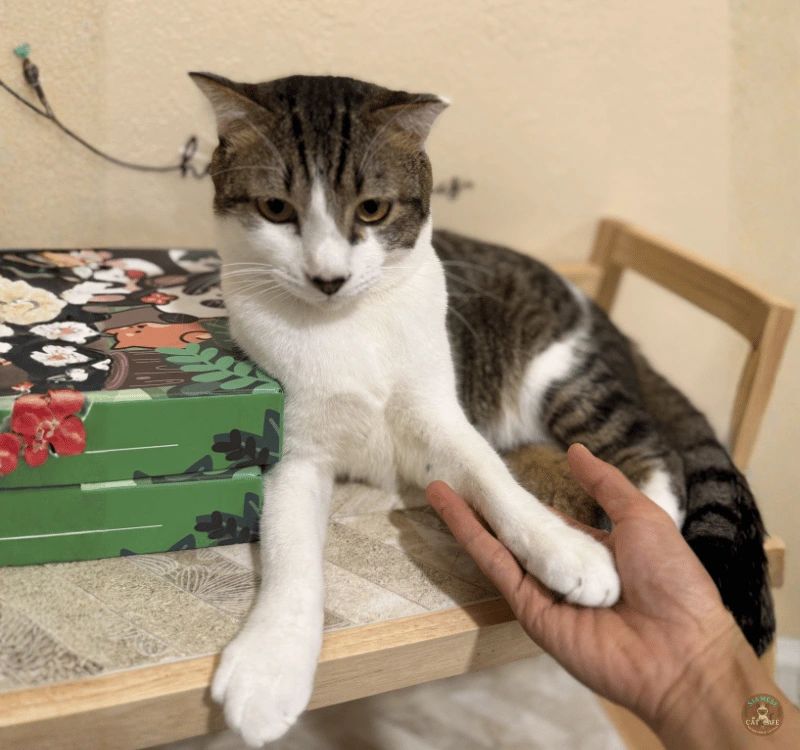
A closer look at Charlie


Charlie’s comedy is physical. He does not need a costume, a clever caption, or a dramatic rescue montage. Give him a floor, an interesting object, and a reason to look upward; he arranges the scene himself.
The three photographs selected for this story form a small performance. They also reveal the part that a quick “playful cat” label misses. Charlie is funny because he commits completely to whatever he is doing, including doing nothing.
Act one: the improbable gentleman
In the first frame, Charlie stands upright on his back legs. His white chest becomes a waistcoat, his front paws hover in front of him, and his expression is unusually formal for such an unlikely posture. The cafe wall, woven rugs, and cat furniture stay perfectly ordinary around him. That contrast creates the joke.
The cafe’s profile connects his name with Charlie Chaplin and records that he was rescued in Rayong. This scene stays with what a visitor can actually read from the frame: curiosity has pulled his whole body upward.
If Charlie stands to inspect something, let the investigation finish. Reaching in to steady him or touching his tail changes a self-directed moment into one he has to manage.
Act two: the joke becomes a chase
The second frame catches Charlie stretched across the floor toward a small dark toy. The posture is exaggerated, but the intention is precise. His front half is committed to the object while the rest of him seems to have arrived a second later.
This is where visitors can participate. A toy creates distance, movement, and choice without requiring hands on the cat. Move it in short, readable motions and pause long enough for Charlie to decide whether the game continues. The pause is part of play, not a failure of it.
Charlie’s current profile lists favorite toys, but repeating a catalogue would add little. The photograph gives the more useful information: he likes a game that lets him watch, calculate, and make one sudden move.
Act three: the performer clocks out
The last photograph removes the action. Charlie is settled into a soft chair, his body folded into the fabric and his attention no longer directed toward a prop. The comic timing comes from placement. After two frames of effort, he looks like an actor who has decided the audience can entertain itself.
Rest completes the portrait. A cat who played a moment ago is not automatically available now. Let the chair remain his, keep greetings quiet, and accept that the final act may be a nap.
Charlie’s distinctiveness lives in that range: upright inspection, full-body play, then absolute rest. Visitors do not need to provoke the funny version of him. Watch long enough, respect the transitions, and Charlie usually finds his own punchline. The laughter is better when nobody has to ask for it.
The sequence works because no single frame is asked to define him. Comedy, concentration, and rest all belong to the same cat. By the final photograph, the chair has become his dressing room and the audience has been dismissed. Charlie never needed us to supply the joke; we only had to notice when he delivered it.
Charlie’s three-act sequence moves from upright curiosity to committed play and a perfectly timed rest.