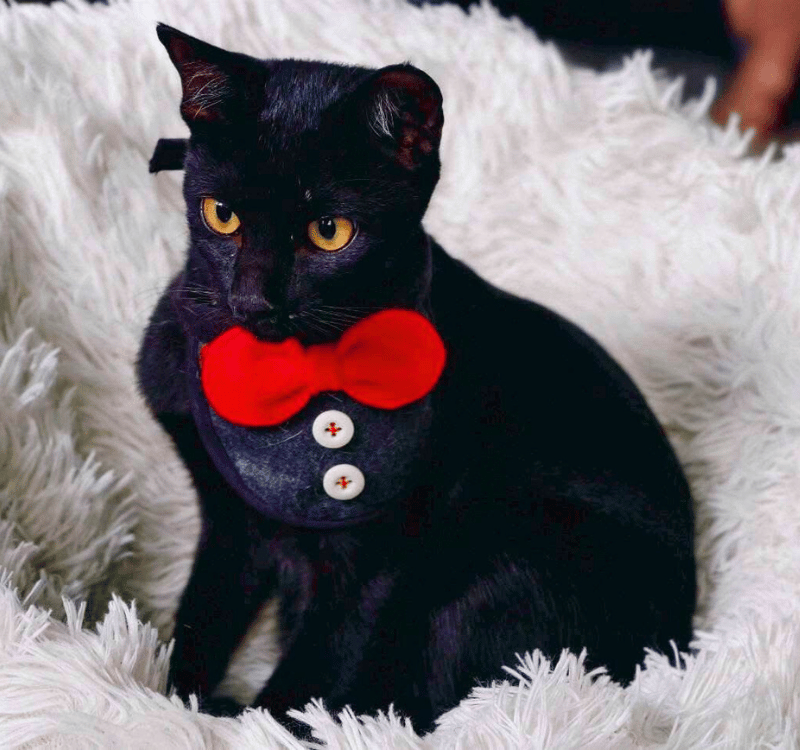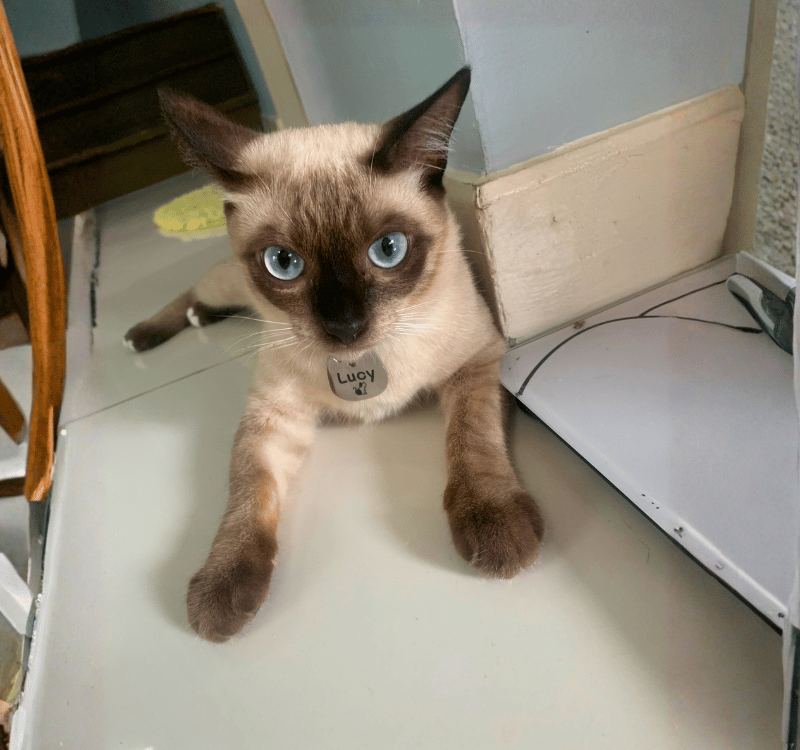
Named after: “Little girl” or “grace,” and she truly lives up to her name.
Personality: Gentle and thoughtful, Nina loves quiet corners filled with sunlight.
Rescue Story: Born alongside Mira in the café family, Nina represents our promise: every life — rescued or not — is nurtured with the same warmth and affection.
A closer look at Nina


Nina’s first frame contains a doorway, and she appears to understand exactly what a doorway is for. It is not merely an entrance. It is a place to stop, gather information, and decide which side of the room deserves the next step.
Her spotted Bengal coat creates immediate visual energy. Her posture is more measured.
Frame one: the decision point
Nina sits just inside the cafe threshold on a dark mat. The chairs and warm interior are visible behind her. Her front paws are aligned, her ears are upright, and her gaze is angled slightly above the camera.
This is a strong visitor image because it corrects a common mistake. A cat near an entrance is not necessarily there to greet everyone crossing it. Nina may be monitoring sound, movement, another cat, or the route itself.
Pause before stepping into her line. Leave enough room for her to move forward, sideways, or back into the cafe. A greeting that preserves all three options is more useful than a hand placed directly in front of her face.
Frame two: the room from above
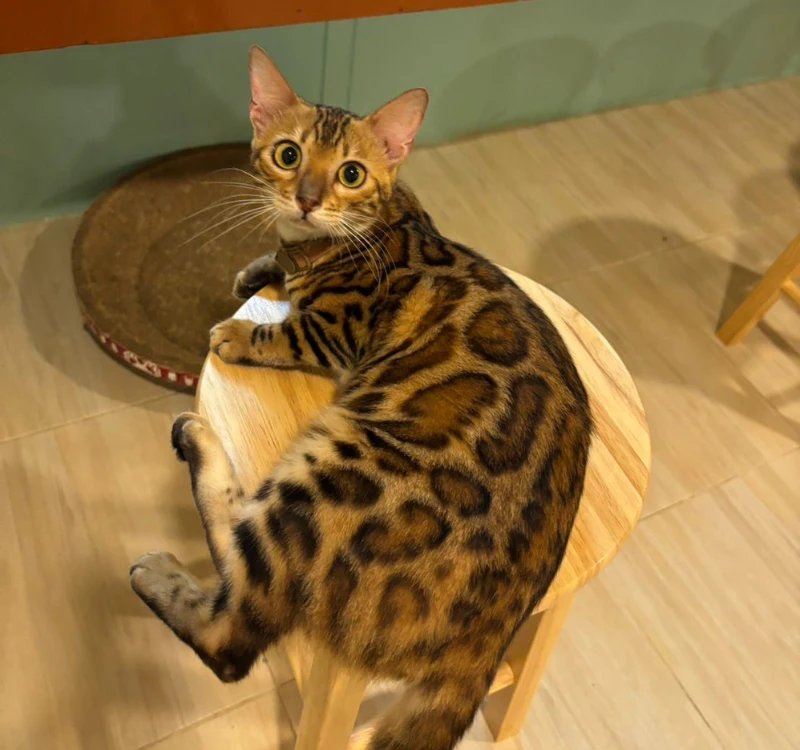
The second photograph finds Nina inside a round wooden cat-tree bed. Only the upper part of her body rises over the edge, while furniture and cafe floor sit below.
The raised position changes what she can see and how easily others can reach her. Treat the height as a boundary rather than an invitation. Do not pull her toward the opening or tap the surface to obtain eye contact.
The cafe’s profile identifies Mira as Nina’s twin and says they were born into care, although the published dates conflict and require correction. The photographs stay with Nina’s way of gathering information from a place she selected.
Frame three: curiosity comes closer
In the final frame, Nina is near a woven cafe chair, her face closer to the camera and her eyes fully engaged. Her rosetted coat remains visible, but the expression now carries the composition.
This might be the moment to offer a toy or a low hand. It is still not a promise. Let her inspect, withdraw, or continue past. If she turns toward a sound or toward Mira, the interaction can end without becoming unsuccessful.
The three frames form a pattern without pretending to diagnose her personality: doorway, lookout, closer view. Nina moves through distance in stages. Visitors who notice those stages can meet her without collapsing them into one demand for attention.
She does not need to be the cafe’s automatic greeter. She can be the cat who studies the doorway and crosses it when the room makes sense. That held breath before she moves is not empty time; it is the part visitors get to share.
Her biography supplies identity and family history. The new sequence gives the visitor something harder to summarize: the pleasure of waiting while a decision forms. A paw shifts at the doorway, the lookout becomes less necessary, and the distance may shorten by one deliberate step. With Nina, anticipation is not the delay before the encounter. It is the encounter.
Nina’s sequence moves from threshold to lookout to closer attention, always at a pace she controls.